
Overview & Epistemological Paradigm
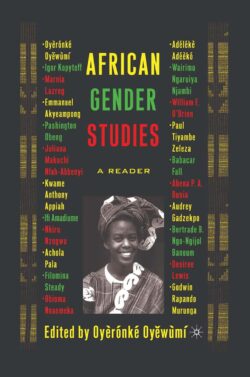
Edited by decolonial feminist scholar Oyèrónké Oyěwùmí and published in 2005 by Palgrave Macmillan, African Gender Studies: A Reader is a landmark anthology in decolonial feminist epistemology. The collection is dedicated to Nobel Peace Laureate Wangari Maathai, who taught that “in order to make change, we must take charge”.
Oyěwùmí’s foundational thesis asserts that the conceptual categories of gender and sexuality used in global academia are fundamentally Western cultural exports. In her preface, she demonstrates that Western gender categories are an outgrowth of “biological foundationalism”, an ideology where physical bodies provide the inevitable rationale for organizing the social world, a cultural logic she terms “bio-logic”. The book’s core objective is to challenge this uncritical imposition of Western, biologically deterministic concepts on African realities. It argues that Africa must be studied on its own terms and that endogenous African knowledge must be a foundational factor in global social theory.
The text comprises twenty-two chapters divided into seven sections, with each section preceded by an analytical introduction.
Section I: Transcending the Body of Knowledge
Chapter 1: Visualizing the Body: Western Theories and African Subjects (Oyèrónké Oyěwùmí)
Oyěwùmí traces the genealogy of somatocentrism (the visual prioritization of physical bodies) in Western social science. This biological determinism enjoys continuous credence from Socrates’ “noble lie” (which used metals gold, silver, brass, iron to naturalize social hierarchy) to modern sociological categories.
She contrasts this Western visual bias (ocularcentrism) with ungendered African world-senses. While Western thought privileges sight (which is forward-facing, linear, and limited to surfaces), sensory systems like the Yorùbá world-sense operate in “acoustic space,” where sound is proximate, surrounds the perceiver, and penetrates beneath the surface.
Oyěwùmí critiques Western researchers for bringing this “body-reasoning” to Africa, imposing the biological cohort of “women” on non-body-based social categories. For example, in her critique of Claire Robertson’s socioeconomic history of the Gã (Sharing the Same Bowl), Oyěwùmí shows that Robertson was forced to shift her focus from “women” to “traders” because trading was historically non-gender-specific. Starting with “women” introduced a visual, body-based distortion into an ungendered market system.
Chapter 2: Spirituality, Gender, and Power in Asante History (Emmanuel Akyeampong & Pashington Obeng)
The authors historicize the concept of power (tumi) within the centralized Asante state, which was formed by Twi-speaking Akan matriclans (mmusua, sing. abusua) at the turn of the eighteenth century and fell to British rule in 1896. They challenge state-centric historiographies by demonstrating that Asante power was diffuse, relational, and deeply intertwined with the metaphysical and spiritual realms.
In the pre-centralization era, the Akan forest dwellers prioritized collective survival through forest-taming values like nkabom (cooperation), nkosoo (progress), and asomdwee (peace). Although early history was characterized as the “era of great ancestresses,” the rise of a militaristic state under Osei Tutu and the high priest Okomfo Anokye (who conjured the Golden Stool, Sika Dwa Kofi, as the soul of the nation) shifted power toward masculine military prowess.
Men claimed the exclusive right to sentence to death and let blood flow. Pre-menopausal women were sidelined from state affairs due to menstrual blood taboos, which were believed to threaten the spiritual purity of ancestral stools and shrines, while post-menopausal women could act as “ritual men” (drinking liquor, cutting hair short, and pouring libations). During wars, women waged spiritual warfare (mmomomme) by processing in partial nudity, chanting, and pounding empty mortars to torture enemies spiritually.
The authors analyze three moments of crisis where state power was challenged:
- The 1818–1819 Palace Coup: Led by the queen mother (asantehemaa) Adoma Akosua and seventeen royal wives while the king was away at war with Gyaman. The rebellion was crushed, the wives decapitated, and the sister strangled to prevent the profanation of spilling royal blood. Adoma Akosua was replaced and her descendants barred from office.
- The Domankama Movement: A spiritual back-to-our-roots movement in the 1870s following military defeat.
- The 1900 Yaa Asantewaa War: Instigated when the British demanded the Golden Stool; the queen mother Yaa Asantewaa challenged the male chiefs to swap loincloths for her undergarments (“Montu mo danta mma me na monnye me tam”), taking command of the Asante military forces.
Section II: Decolonizing Feminisms
Chapter 3: Bringing African Women into the Classroom: Rethinking Pedagogy and Epistemology (Obioma Nnaemeka)
Nnaemeka interrogates the tokenism, commodification, and objectification of African women in Western academic spaces. She highlights how Nawal El Saadawi’s landmark book The Hidden Face of Eve had its crucial political and historical preface completely excised from the American edition published by Beacon Press. This excision stripped Saadawi’s analysis of its structural critique of Western imperialist intervention in the Middle East, reducing her book to a sensationalized account of physical clitoridectomy. Nnaemeka similarly critiques how Gloria Steinem cut Saadawi’s political and historical context in Ms. magazine, leaving only personal statements.
Nnaemeka cautions against both the romanticization of African cultures by “insiders” and the ethnocentric pathologizing of African traditions by Western “outsiders,” praising Chinua Achebe for balancing cultural identification with critical distance. She warns against syllabus tokenism, where single works of African fiction are used to check off “race, gender, and class” in a superficial bid for multiculturalism. She notes that African women writers are not easily interchangeable (e.g., Bessie Head, Aminata Sow Fall, Flora Nwapa).
She also deconstructs Western ridicule of “arranged marriages” by comparing them to Western commercial dating services and television shows like “Love Connection,” where families are rapidly commodified under the guise of “choice”. Retooling oneself, rather than relying on “unreal loyalties,” is essential for teaching across cultures.
Chapter 4: Decolonizing Feminism (Marnia Lazreg)
Lazreg explores the methodological struggles of researching Algerian women under the dual overdetermining frameworks of colonialism and Islam. She critiques Western feminist scholarship for mimicking male theological discourses by reducing Algerian women to either passive victims of Islam or direct embodiments of it a dynamic she terms the “religion paradigm”. The veil is obsessively researched as a supreme symbol of oppression while its strategic, mundane, and varied uses by women are ignored.
Drawing on Lucien Goldmann’s genetic structuralism, she argues that researchers must look at Algerian women as active, “transindividual subjects” who operate within class and historical webs. Lazreg frames cross-cultural feminist research as entering a “Pascalian wager” accepting uncertainty while insisting on the primacy of the human over the cultural.
Section III: Reconceptualizing Gender
Chapter 5: Theorizing Matriarchy in Africa: Kinship Ideologies and Systems in Africa and Europe (Ifi Amadiume)
Amadiume theorizes matriarchy as a structural system operating alongside patriarchy rather than an absolute, totalitarian “female rule”. She refutes Henry Maine’s Ancient Law, showing that his model of primordial patriarchy was derived exclusively from Indo-European histories and falsely projected as a universal human origin.
Drawing on Cheikh Anta Diop’s “two-cradle theory,” she highlights how precolonial African social systems were fundamentally matrilineal and matriarchal in terms of property transmission, with systemic masculinization occurring only through Arabo-Islamic and European colonial invasions. Diop’s research demonstrates that material conditions, not race, govern the transition between systems. Amadiume also critiques John McLennan’s wife-capture and exogamy theories, which objectified women as tradeable items in male-managed warfare.
In her Igbo case study, matriarchy and patriarchy operate as dynamic, gendered ideological systems:
- The male Obi (ancestral house): Represents competitive, jural force, masculinism, and violence, governed by the patrikin ideology of umunna (common fatherhood).
- The female Mkpuke (matricentric unit): Represents collectivism, moral force, and the ideals of compassion, love, and peace, governed by the matriarchal ideology of umunne (common motherhood) under the spiritual custody of the goddess Idemili.
She contrasts these African structures with Wendy James’ study of matrifocality among the Uduk on the Sudan-Ethiopia border, Paul Riesman’s Jelgobe data (wuro vs. ladde), and Maurice Bloch’s Merina data, validating Diop’s “Asian Mode of Production” model of matriarchal pacifism versus Greco-Roman patriarchal militarism.
Chapter 6: (Re) constituting the Cosmology and Sociocultural Institutions of Ò·yó·–Yorùbá (Oyèrónké Oyěwùmí)
Oyěwùmí argues that prior to Western colonization, gender was not an organizing principle in Yorùbá society; instead, the primary organizing principle was seniority, defined by relative chronological age.
She demonstrates that the standard English glosses of the Yoruba terms obìnrin and mkùnrin as “female/woman” and “male/man” are fundamental mistranslation errors. In Yoruba thought, these terms suggest anatomical varieties of a common humanity (ènìyàn) rather than a binary, hierarchical opposition. Yoruba lineage, marriage, and markets were gender-free. Lineage identity (ilé) and status were determined by birth order. A consanguinal child of the house is always oko (lineage member, glossed as “husband”) to incoming conjugal spouses, who are aya (consorts, glossed as “wife”), regardless of biological sex.
Chapter 7: Kò Sóhun tí Mbe tí ò Nítàn (Nothing Is that Lacks a [Hi]story): On Oyèrónké Oyěwùmí’s The Invention of Women (Adélékè Adéèkó)
Adéèkó offers an autobiographical reflection on how Oyěwùmí’s theories explain the linguistic and social structures of his own Yorùbá childhood. He details how his mother referred to his wife as “oko mi” (my husband) because his wife married into his father’s household, showing that oko (husband) and aya (wife) are situational, lineage-based locations rather than anatomical categories. He notes that during modernization (òlàjú), generic Yoruba terms (like oba and omo) were erroneously masculinized into “king” and “son” under English translations.
Chapter 8: Women’s Roles and Existential Identities (Igor Kopytoff)
Kopytoff contrasts the existential identities of the West (what a person is inherently) with the role-based identities of the Suku of southwestern Zaire (what a person does). Among the Suku, very few roles are existentially linked to anatomy. While childbearing is existentially female, other tasks like cooking, childminding, and agriculture are negotiable and situational. Suku men easily took on paid jobs as cooks and nannies for Europeans without feeling that these female-associated roles compromised their male existential identities.
Chapter 9: Revisiting “Woman–Woman Marriage”: Notes on Gikuyu Women (Wairimu Ngaruiya Njambi & William E. O’Brien)
The authors challenge narrow, functionalist Western anthropologies (such as Louis Leakey’s) that explain woman-woman marriage in Africa solely as a desperate mechanism for barren widows to secure a male heir. Through interviews with Gikuyu women in central Kenya, they reveal diverse reasons for these marriages:
- Companionship and Loneliness: Appeasing the isolation of widowhood (as expressed by Mbura).
- Property Protection: Collaborative resistance against male relatives seeking to seize land (as detailed by Nduta, who married Ciru on her mother-in-law’s advice).
- Desire to Be Remembered: Secured through the children of the union carrying on the mother’s name.
Gikuyu women reject any male-association or “maleness” in their marital positions, calling each other mutumia wakwa (my wife/co-wife) or muka wakwa rather than using Gikuyu terms for husband (muthuri). Nduta’s children teasingly calling her baba (father) was merely a playful acknowledgment of her city-brought “breadwinner” status, not a masculinization of her identity.
Section IV: Gender Biases in the Making of History
Chapter 10: Making History, Creating Gender: Some Methodological and Interpretive Questions in the Writing of Oyo Oral Traditions (Oyèrónké Oyěwùmí)
Oyěwùmí exposes how written history and “traditions” were constructed during the colonial period to introduce a patriarchal bias into Yoruba oral traditions. Reverend Samuel Johnson’s monumental The History of the Yorubas (1921) systematically masculinized Yoruba royalty. He translated the ungendered Yoruba category omo (offspring/descendant) as “son,” and aremo (first-born) as “Crown Prince,” effectively erasing female agency.
Historical female rulers were either re-categorized as temporary “regents” or described as possessing “masculine” traits to justify their power. For example, the twelfth ruler of Oyo, Orompoto, who reigned for twenty years, was a woman king (oba obinrin), but was written out of the universal male norm. Johnson similarly categorized Omosun as a female first-born who had to be masculinized to explain her bid for the throne.
Oyěwùmí also refutes J.D.Y. Peel’s use of the Yorùbá saying baba ni jingi (“father is a mirror”) to prove a patrilineal-exclusive lineage norm. She points out that the saying belongs to a larger ungendered poem celebrating both parents: “Iya ni wura, Baba ni jingi” (“Mother is gold, Father is a mirror”).
Furthermore, she deconstructs translation errors in P.F. de Moraes Farias’ work on the arokin (royal bards), proving that the oral Yoruba text referred to the Allafin’s omo kansoso (“one and only child”), which was inaccurately translated as “only daughter,” minimizing the tragedy’s dynastic gravity to fit a Western model of male-lineage centrality.
Chapter 11: Gender Biases in African Historiography (Paul Tiyambe Zeleza)
Zeleza conducts a sweeping survey of major African history textbooks, exposing the persistent sexism and marginalization of women. He notes that volumes of the Cambridge History of Africa and the UNESCO General History of Africa systematically ignore women, often containing zero index entries for them. Robert July’s A History of the African People portrays precolonial women merely as “pawns” or “commodities”, while Bill Freund’s The Making of Contemporary Africa categorizes women and youths interchangeably as passive “dependents” of male elders.
Regional histories, such as Jamil Abun-Nasr’s A History of the Maghrib, completely ignore women, while Ajayi and Crowder’s History of West Africa relegates precolonial female chiefs to brief, static anthropological notes. Zeleza also critiques economic and social history models: Walter Rodney’s How Europe Underdeveloped Africa reduces precolonial female power to a secondary footnote, while Martin Klein’s Peasants in Africa, Feierman & Janzen’s The Social Basis of Health and Healing, and John Iliffe’s The African Poor systematically render married, productive women invisible.
Chapter 12: Senegalese Women in Politics: Two Female Leaders, Arame Diène and Thioumbé Samb (Babacar Fall)
Fall uses oral life narratives to document the political itineraries of two non-literate Senegalese women activists from 1945 to 1996, rescuing their voices from elite, French-literate male histories.
- Thioumbé Samb: Formed by the radical nationalist UDS/RDA, which prioritized the political education and training of women to resist colonial oppression.
- Arame Diène: A member of the Socialist Party (formerly BDS) who notes that pre-independence politics was driven by the deep commitment of grassroots partisans rather than the financial “political nomadism” and greed of contemporary politics.
Section V: Writing Women: Reading Gender
Chapter 13: Miscegenation as Metonymy: Sexuality and Power in the Colonial Novel (Abena P. A. Busia)
Busia analyzes the intersection of gender, race, power, and sexuality in imperialist colonial fiction. In Joseph Conrad’s Heart of Darkness, the wild African woman stands on the shore as a silent, inarticulate “gorgeous apparition” representing the untamable, fecund wilderness itself. Conversely, “The Intended” the pale, pure European woman back in Brussels is endowed with a concrete setting, language, and voice, for whom the “noble lie” of Kurtz’s integrity is preserved.
Busia examines how miscegenation operates as the ultimate indicator of moral collapse in Margery Perham’s Major Dane’s Garden (where Blaker’s silent, unspeakable affair with Khedichu leads to his murder) and David Caute’s At Fever Pitch (where the homosexual rape of the African batman Sulley by Michael Glyn represents the violent, castrating logic of imperial conquest).
Chapter 14: Gender, Feminist Theory, and Post-Colonial (Women’s) Writing (Juliana Makuchi Nfah-Abbenyi)
Nfah-Abbenyi critiques Western feminist theorists for treating Third World scholars as mere consumers of theory rather than producers of it. She argues that postcolonial African women’s novels (such as those by Buchi Emecheta, Ama Ata Aidoo, and Tsitsi Dangarembga) are autonomous theoretical texts where theory is embedded in the narrative structure.
Using Werewere Liking’s Bassa-ritual-based epics, she demonstrates the depth of indigenous theory. Nfah-Abbenyi enlists Tsitsi Dangarembga’s Nervous Conditions (Nyasha’s shifting, multi-layered postcolonial identity) and Buchi Emecheta’s The Joys of Motherhood to show that the declaration “You have become a woman” after childbearing highlights that gender in Africa is situational, discontinuous, and negotiable.
Chapter 15: The Hidden History of Women in Ghanaian Print Culture (Audrey Gadzekpo)
Gadzekpo reconstructs the long, hidden history of female writers, columnists, and editors in Ghanaian print culture dating back to the late nineteenth century. She deconstructs the famous 1934 copyright lawsuit over the pseudonym “Marjorie Mensah” in the Times of West Africa, revealing that the column was predominantly written by Mabel Dove Danquah and Ruby Quartey-Papafio. She also uncovers that “Gloria” the regular women’s columnist for the Gold Coast Times (1936–1940) was actually the prominent educator Mercy Quartey-Papafio (Mercy Ffoulkes-Crabbe), whose identity was discovered via papers found in her personal tin trunk by her daughter, Dorothy Jane.
Section VI: Development and Social Transformation
Chapter 16: Definitions of Women and Development: An African Perspective (Achola O. Pala)
Pala critiques top-down Western development paradigms for ignoring African realities. She posits that the contemporary socio-economic status of African women must be understood as a dynamic interplay between dependency (colonial and neocolonial economic exploitation by Europe and the US) and indigenous socioeconomic norms (local family structures, property rights, and respect). She enlists Sembene Ousmane’s God’s Bits of Wood and Peter Abrahams’ Mine Boy to illustrate the realities of female labor in colonial mines and slums.
Chapter 17: An Investigative Framework for Gender Research in Africa (Filomina Chioma Steady)
Steady outlines how corporate globalization, Structural Adjustment Programmes (SAPs), and privatization have devastated African ecosystems and economies, disproportionately impacting women. She calls for an Africa-centered research methodology that rejects Western dichotomous gender frameworks, celebrating the groundbreaking work of Amadiume and Oyěwùmí in deconstructing the term “gender”.
Chapter 18: The Yum: An Indigenous Model for Sustainable Development (Bertrade B. Ngo-Ngijol Banoum)
Banoum presents a concrete case study of endogenous development in Bogso, Cameroon. Facing severe food shortages in the early 1990s, rural peasant women organized under the leadership of Teclaire Ntomp. They mobilized the traditional, collective labor model of Yum (where community members cooperatively farm individual plots of land) to systematically scale up cassava production. Their self-sufficient initiative successfully eradicated local hunger and evolved into a globally recognized cooperative network.
Section VII: Critical Conversations
Chapter 19: In My Father’s House: Epilogue (Kwame Anthony Appiah)
Appiah details the intense personal and political battles that erupted in Kumasi following the death of his father, Joe Appiah. Joe Appiah’s deathbed codicil requested a Christian funeral controlled by his English wife Peggy and his children. This directly challenged Asante custom, where the funeral is strictly the jurisdiction of the matrilineal clan (abusua).
Appiah details his confrontation at the palace of the king of Asante (Asantehene Opoku Ware II, his uncle) and his aunt Victoria. Appiah walked out on the king in a fit of rage over the abusua’s attempts to delay and hijack the corpse. The family feud involved the casting of spells through sheep slaughtering, counter-juju (sacrificing a white chicken and doves to protect the household from magical poisoning), and the political intervention of Head of State Jerry Rawlings.
Chapter 20: Questions of Identity and Inheritance: A Critical Review of Kwame Anthony Appiah’s In My Father’s House (Nkiru Nzegwu)
Nzegwu delivers a devastating critique of Appiah’s book, accusing him of executing a covert “patrilinealization” and recolonization of Asante society. She argues that Appiah privileges an Anglo-Saxon, biology-focused view of fatherhood and inheritance while actively demonizing the matrilineal abusua system.
In Asante customary law, ethnic identity and inheritance are determined solely by the mother’s blood (mogya). Appiah, having an English mother, lacks an Asante abusua and is technically a “stranger” to the lineage. Joe Appiah’s wealth belonged to his matriclan (having inherited it from his uncle Yao Antony). By using a Western codicil to appropriate this wealth for his biracial children, Joe Appiah and his son committed a “violent rape” of the abusua’s fiduciary assets, using global academic platforms to represent a mother-focused system as backward and oppressive. Nzegwu notes that Appiah’s upbringing in Mbrom behind his mother’s rose garden, playing Tarzan, alienated him from the ancestral abusua protocols.
Chapter 21: African Gender Research and Postcoloniality: Legacies and Challenges (Desiree Lewis)
Lewis critiques the historical dominance of insular Western anthropology and technocratic development initiatives that freeze African women as static, historical subjects. She champions interdisciplinary, biographical, and poststructuralist approaches, citing Laetiticia Mukurasi’s Post Abolished (documenting a woman’s battle against employment discrimination in Tanzania) and Ngaiza and Koda’s The Unsung Heroines.
Chapter 22: African Women in the Academy and Beyond: Review Essay (Godwin Rapando Murunga)
Murunga reviews key academic works on gender struggles in publishing and universities, criticizing the institutional gatekeeping (like peer-review) that marginalizes non-Western voices. He critiques the institutional barriers analyzed by Penda Mbow (University of Dakar) and details Isabel Apawo Phiri’s harrowing battles against campus sexual harassment and student/media backlash in Malawi.
He also reviews We Only Come Here to Struggle, a life history of Kamba trader Berida Ndambuki. Berida rejected a pre-arranged marriage and survived an alcoholic husband. Murunga highlights how Berida’s story exposes the limits of Western feminist theory; while Western scholars insist on divorce as the solution to domestic abuse, Berida chose to remain married for life while maintaining absolute economic independence, proving that local survival often prioritizes pragmatism over academic dogmas.