
Overview
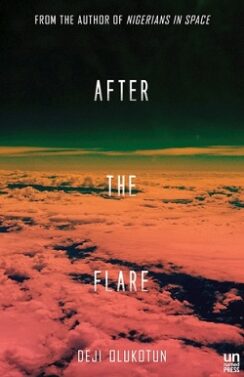
After the Flare is a science fiction novel by Deji Bryce Olukotun, published in 2017 by The Unnamed Press. It is the sequel to his debut novel, Nigerians in Space. The story is set in a near-future Nigeria that has become the unlikely savior of global space exploration after a catastrophic solar event known as “the Flare” devastates most of the world’s technological infrastructure. The novel blends Afrofuturism, political thriller, archaeological mystery, and space opera into a narrative that explores themes of identity, diaspora, cultural heritage, technological ambition, and survival.
The protagonist, Kwesi Bracket, is an African American engineer who has relocated to Nigeria to work on a rescue mission for a stranded astronaut. As he navigates the complexities of Nigerian culture, institutional politics, and a mysterious ancient power buried beneath the spaceport, he must also confront his own personal demons and the fractured state of the post-Flare world.
Prologue: The Catastrophe
The novel opens with a vivid depiction of the Flare from the perspective of Masha Kornokova, a Russian cosmonaut aboard the International Space Station. She has just completed a six-hour spacewalk when an intense light a coronal mass ejection of unprecedented magnitude engulfs the Earth. The light blinds her momentarily, and when she can see again, the planet below is bathed in strange, dancing colors before falling dark. Moscow and Berlin, previously visible as pinpricks of light, are extinguished. The space station’s electronics are fried; emergency lighting casts a washed-out pall over the modules.
Kornokova and her fellow crew members Stankov, Jeppsen, and Hiroyuki scramble to respond. Stankov’s suit liner catches fire during the chaos, and Kornokova uses a foam suppressant to save him, though he suffers third-degree burns. The crew gathers in the Soyuz escape capsule, where they receive instructions from Mission Director Josephine Gauthier in Paris. Gauthier explains that the Flare has destroyed electricity transformers across North America, Europe, and Asia. The world has gone dark. The station’s propulsion systems are damaged, and orbital decay is imminent. The plan is to evacuate, but there is only room for three in the Soyuz capsule. Stankov, injured and needing medical attention, is ordered to evacuate. Kornokova, uninjured and having trained for such contingencies, volunteers to remain behind.
The emotional core of the prologue is the relationship between Kornokova and Gauthier, who are lovers. Their farewell is poignant and restrained, with Kornokova declaring her love over an open channel despite the crew’s knowledge of their relationship. Gauthier promises to come back for her. Kornokova begins her inventory of supplies, preparing for a long, solitary stay in orbit, three hundred kilometers above the woman she loves.
Chapter 1: Kano, Nigeria One Year Later
The narrative shifts to Kano, Nigeria, one year after the Flare. Kwesi Bracket, an industrial engineer from NASA, is now working at the Nigeria Spaceport, where he is overseeing the construction of Naijapool, a massive neutral buoyancy tank designed for astronaut training. The spaceport is a hub of activity, with Nigerian and Indian scientists collaborating on a mission to rescue Masha Kornokova, who remains stranded aboard the ISS.
Bracket’s day begins with a crisis: workers have discovered a small ceramic artifact a piece of old pottery during excavation near Naijapool. One of the workers, Abdul Haruna, has taken it and fled. Bracket chases him across the spaceport, through bulldozers and excavators, toward a large array of radio antennae. Abdul climbs one of the antennae, and when Bracket follows, the dish begins to pivot, nearly throwing him to his death. Abdul jumps and disappears behind a low, flat building. When Bracket and the workers reach the spot, they find only a pool of blood spreading on the ground. Abdul has vanished “like smoke,” the workers say. Some believe it was magic.
Bracket is skeptical but disturbed. He collects some of the blood on his torn shirtsleeve, wraps it in a plastic bag, and decides to consult Op-Sec (Operational Security) rather than the police. The workers’ testimonies are contradictory and fearful; some claim Abdul simply disappeared into the ground, leaving behind only blood. Bracket is unnerved by the old building they find nearby it contains a machine labeled “BENDIX,” which he later learns was part of a NASA tracking station from the 1960s.
Chapter 2: Bracket’s Background
This chapter provides Bracket’s backstory. He had once believed that moving to Africa would be a homecoming, a chance to reconnect with his ancestral roots and escape the stagnation of his career at NASA. His mother had raised him on stories of Africa, dressing him in dashikis and instilling in him a belief in a glorious Nubian destiny. But the reality of Nigeria its complexities, its tribalism, its corruption has been disorienting.
When the Flare hit, Bracket was working at NASA’s Neutral Buoyancy Laboratory in Houston. The world he knew collapsed: no electricity, no plumbing, no air conditioning. The United States fractured along ideological lines. Progressives flocked to the Southwest to form the Pueblo Confederacy; the affluent locked themselves in coastal enclaves like the Silicon Territories; and the Wallers armed survivalists prepared for a battle for resources. Meanwhile, a narrow band along the equator, including West Africa, had been protected from the Flare by Earth’s magnetic fields. Nigeria, untouched, became the unlikely leader in space exploration.
Bracket received an airmail letter from Nigeria’s National Space Research and Development Agency, inviting him to design and operate a simulation tank. He applied, passed a DNA test (barely he scored one-sixteenth Igbo and one-sixteenth Seminole), and boarded a C-5 military transport to Kano. His daughter, Sybil, remained in Grenada, where she was attending medical school at a Yale-affiliated campus.
Chapter 3: The Spaceport and the Artifact
Bracket returns to his office, where he debriefs the three witnesses who saw Abdul disappear. Their testimonies are recorded:
- Sandton Magu insists he did not attack Abdul and believes the thief is still out there.
- Billy Madueke describes Abdul as quiet and secretive, not surprised he was a thief. He saw Abdul fall before disappearing and noticed blood “like a cow’s throat had been slit.”
- Handsome Amaechi says Abdul looked sick before he vanished, as if he was about to vomit, and that the pot went with him.
Bracket is deeply unsettled. He composes an incident report for Op-Sec but deletes it, deciding to bring the matter to Josephine Gauthier in person. He retrieves his Geckofone a bio-inspired device that resembles a gecko and sends her a message. He also reads a message from his daughter, Sybil, who is doing well in Grenada but hints at a new boyfriend named Thurston. Bracket is protective and suspicious.
Josephine summons him to the Nest, the mission control tower. On his way, he observes the spaceport’s facilities: the rocket platforms, the prep rooms, the bronze replica of the Masquerade (the ship being built to rescue Kornokova), and the diverse staff of Nigerians, Indians, and others.
Chapter 4: The Meeting with Josephine
Bracket meets with Josephine Gauthier, the mission director. She is a French-Guadeloupian woman with a reputation for ruthlessness and a habit of making discriminatory remarks about Africans. She is also secretly Masha Kornokova’s lover. Josephine is under immense pressure: the rescue mission is behind schedule, the pool is not yet filled, and Nurudeen Bello, the politician who founded the spaceport, is expected to visit.
Bracket tells her about Abdul’s disappearance and the artifact. Josephine is alarmed not because of the blood, but because the artifact could be cultural patrimony. The land was purchased from the Emir of Kano with the promise that any historical findings would be turned over to him. If the emir learns of the artifact, the mission could be halted. Josephine orders Bracket to keep quiet, delete the witnesses’ employment files, and fill the pool immediately.
Their conversation is tense. Josephine accuses Bracket of being lazy and unprofessional, blaming him for the delays. She threatens to replace him with one of the Indian engineers. Bracket is frustrated but knows he has no choice. He mentions the Bendix machine, and Josephine dismisses it as a chocolate company. She gives him until Thursday to fill the pool.
Chapter 5: The Consecration Ceremony
That night, spiritual leaders from across Nigeria gather at the spaceport for the consecration of the bronze replica of the Masquerade. The Emir of Kano arrives on horseback with his cavalry, and Nurudeen Bello a charismatic politician and former whistleblower presides over the ceremony. Bello delivers a rousing speech about Nigeria’s destiny in space, invoking the image of seeds that only propagate through fire. The Masquerade replica is blessed by soothsayers, priests, and elders from various ethnic groups.
During the banquet, Bracket meets Seeta Chandrasekhan, a vibroacoustic engineer from India. She is intelligent, opinionated, and attracted to Bracket. They dance together, and later she invites him back to her trailer, where she spins music for him a mix of natural sounds and electronic beats. They have a brief, intense sexual encounter. Bracket learns that Seeta has a girlfriend back in Delhi, but the relationship is strained by the Flare.
Chapter 6: The Journey to Kano
The next morning, Bracket and his fixer, Max Obinna, drive into Kano to find cable for the pool. Max is a resourceful Nigerian who navigates the city’s checkpoints, markets, and tribal tensions with ease. They visit Ibrahim Musa, a wealthy trader who agrees to sell Bracket the cable in exchange for cowries and groundnuts. Musa warns Bracket about the Jarumi a militant group also known as Boko Haram who are rumored to be planning an attack on Kano.
On their way back, Bracket and Max are caught in a suicide bombing near a soccer stadium. A young pregnant girl detonates herself after being stopped at a police checkpoint. Bracket and Max survive, but the explosion kills many others. Bracket sees a Wodaabe woman a member of a nomadic Fulani subclan running toward the bomber, singing. He is shaken by the experience.
Chapter 7: Balewa’s Story
This chapter introduces Balewa, a young Wodaabe woman who was raped by Jarumi militants and is now pregnant with her rapist’s child. She has discovered a set of powerful stones Songstones in a hidden underground chamber. The stones respond to music and can create protective fields. Balewa is torn between her desire to abort the child and the pressure from the other Wodaabe women to keep it. She is also haunted by the memory of the suicide bombing, where she tried to use her Songstone to stop the girl but failed.
Balewa and the other women Abir, Durel, and others have taken refuge in the underground chambers, which they believe were built by their ancestors. They practice with the Songstones, learning to amplify their power through music. Durel, the eldest, is skeptical and wants to leave, but Balewa is determined to master the stones and use them to rescue the children who were kidnapped by the Jarumi.
Chapter 8: Aftermath of the Bombing
Bracket and Max help the victims of the bombing. Bracket is questioned by police, who confiscate his passport. He returns to the spaceport, where he finds his trailer covered in silt from the Harmattan winds. He showers, picking glass from his skin, and tries to relax by watching Nigerian television specifically, a Nollywood show called Mrs. N Hires the Help. He messages Seeta, but she doesn’t respond.
He thinks about the Wodaabe woman he saw at the bombing and wonders why she ran toward the suicide bomber. He also thinks about the Jarumi and realizes that if they attack the spaceport, they will target the Naijanauts the Nigerian astronauts because they are the public face of the mission.
Chapter 9: Detective Idriss and the Investigation
Bracket meets with Detective Idriss, a principled but overworked police officer in Kano. Idriss reveals that the blood Bracket found belongs to the Kanuri ethnic group the same group from which many Jarumi militants are drawn. He suggests that Abdul Haruna may have been a member of Boko Haram, sent to steal or sabotage the spaceport. Idriss also mentions that the Wodaabe woman Bracket saw at the bombing has not been found, and that the suicide bomber was a pregnant fifteen-year-old girl from Borno State.
Bracket asks Idriss to investigate the intruder who broke into his quarters, but Idriss explains that he cannot conduct an investigation on the spaceport without an official invitation. He also mentions the case of an albino man who has been accused of child abductions a superstition that leads to the murder of albinos for their body parts.
Chapter 10: Seeta’s Discovery
Bracket asks Seeta to scan Naijapool for structural integrity. She agrees but is distant, still conflicted about their encounter. She reveals that her acoustic tests have picked up something strange beneath the pool a large, living entity that moves in all directions at once. She plays a recording of the sound: a low pitch that rises to an A tone (440 Hz), followed by an undulation like a heartbeat. Bracket is unnerved but decides to keep it quiet for now.
That night, Seeta visits Bracket’s trailer with palm wine. They talk about their relationship, and Seeta admits she broke up with her girlfriend before coming to Nigeria. They are about to have sex when an intruder breaks into the trailer. The intruder is not human it is a towering, shifting presence with electric skin and a crown of wires. It attacks Bracket and Seeta, throwing them around the trailer, before leaping into the night. Bracket is left terrified and confused.
Chapter 11: The Wodaabe Women
Balewa and the other Wodaabe women continue to practice with the Songstones. Balewa is still determined to abort her child, but the other women pressure her to keep it. They argue about whether to stay in the underground chambers or return to their migration routes. Durel wants to leave, but Balewa insists that the chambers are their new watering hole a place of safety and power. She demonstrates the Songstone’s power by crushing a teakettle, proving that they can defend themselves against the Jarumi.
Chapter 12: The Artifact and the Creature
Bracket and Seeta examine the artifact that Walid, a member of Bracket’s crew, gave him. It contains a black stone a meteorite with strange carvings. Seeta suggests that the stone responded to sound, and that the markings might be a form of musical notation. Bracket contacts his friend Onur, a geologist, who refers him to Dr. Wale Olufunmi, an expert on meteorites and archaeology.
The creature that attacked Bracket’s trailer remains a mystery. Seeta locks the artifact in the engine-testing lab for safekeeping. Bracket is left wondering if the creature was after the artifact and if it will return.
Chapter 13: The Actors Arrive
Nurudeen Bello’s fiancée, the famous Nollywood actress Omotola Taiwo, arrives at the spaceport with a film crew to shoot a promotional movie about the rescue mission. She is demanding and narcissistic, and Bracket is tasked with accommodating her. He arranges for the actors to film at Ibrahim Musa’s compound, where they can use his swimming pool. Meanwhile, Bracket continues to worry about the creature and the Jarumi threat.
Chapter 14: The Police Station
Bracket visits Detective Idriss again and learns more about the history of the spaceport. The Bendix machine was part of a NASA tracking station that operated in Kano during the 1960s. Idriss’s father worked there. The station was shut down abruptly, and Idriss suspects it was because of strange anomalies. Bracket also witnesses the torture of a young Jarumi suspect, which disturbs him.
Idriss shows Bracket a caged snake eagle that the Jarumi use to intercept surveillance drones. He also reveals that the Jarumi are planning another attack on Kano. Bracket returns to the spaceport, where he finds that his Geckofone has been attacked by a cybernetic spider a zero-day exploit that infected several devices on the base.
Chapter 15: The Spider and the Fish
Ini, a transgender woman working in Digital Security, helps Bracket neutralize the spider. She reveals that the spider was designed to infect Geckofones and that it was made in Nigeria. She also tells him that the attack was likely orchestrated by someone wealthy and connected possibly Senator Kidibe, a corrupt politician.
Meanwhile, Santander, a marine biologist, discovers a school of fish in Naijapool that display unusual schooling patterns forming shapes like squares and triangles. Seeta is intrigued, but Bracket is more concerned about the creature that attacked him and the Jarumi threat.
Chapter 16: The Film and the Test Launch
The promotional film is broadcast nationwide, and the spaceport prepares for its first crewed test launch. Josephine is on edge because Bello has disappeared, and the Jarumi are approaching Kano. Bracket suggests they tell the staff that Bello will be present at the launch to boost morale. Josephine agrees.
Bracket meets with Dr. Wale Olufunmi, who has arrived at the spaceport and claims to have been part of Bello’s original space program. Wale is arrogant and condescending, but he is also genuinely interested in the artifact. Bracket takes him to see it, and Wale confirms that it contains a meteorite a rare type called a eucrite.
Chapter 17: The Launch and the Wodaabe Attack
The Masquerade, the Nigerian spacecraft, successfully completes its first uncrewed test launch and landing. Bracket is elated, but his joy is tempered by the news that the Jarumi are attacking Kano. He also learns that Santander heard a voice in the pool a “longing” or “lamentation” that matches Seeta’s recordings.
The Wodaabe women, led by Balewa and Durel, use their Songstones to attack the Jarumi camp. They rescue some of the captive women and children, but they are unable to find their own children, who have been sold. They capture Latif, the man who betrayed them, and take him back to the underground chambers.
Chapter 18: The Underground Chambers
Bracket, Seeta, and Wale are captured by the Wodaabe women and taken into the underground chambers. They learn that the women have been using the Songstones meteorites that respond to music to protect themselves. The chambers are ancient, covered in inscriptions and carvings that Wale believes belong to the Nok civilization. The women are hostile at first, but Bracket convinces them that he can help find their children.
Wale tries to attack the women with a Taser hidden in his cane, but he is overpowered. Bracket promises to help the women find their children, and they agree to let him and Seeta go. Wale remains behind to study the chambers.
Chapter 19: The Rescue Mission
The Masquerade launches with a crew of Nigerian astronauts to rescue Masha Kornokova. During the mission, a porthole is damaged, and the crew must use a 3D printer aboard the ISS to manufacture replacement rivets. Bracket coordinates the underwater simulations at Naijapool, and the mission is a success. Kornokova is rescued and returns to Earth.
Chapter 20: The Aftermath
The novel concludes with Bracket reflecting on the events. The Wodaabe women have left to search for their children, and Bracket has been given a Songstone by Balewa. He has also learned that Nurudeen Bello’s grand vision for Nigeria includes asteroid mining and a permanent space station at the L4 Lagrangian point. Bracket is skeptical but intrigued.
Epilogue: Ten Years Later
The epilogue is set ten years after the rescue mission. Bracket and Seeta are traveling to the River, a colossal space station built by Nigeria and its allies. The station is a mining facility that extracts resources from asteroids using Noktech technology derived from the Songstones. Bracket’s daughter, Sybil, is now a doctor on the station. Bracket reflects on the journey that brought him to this point, and the novel ends with a sense of hope and possibility.
Themes and Analysis
After the Flare explores several themes:
- Afrofuturism: The novel imagines a future where Africa, specifically Nigeria, becomes a leader in space exploration. It challenges Western-centric narratives of technological progress and celebrates African ingenuity and cultural heritage.
- Identity and Diaspora: Bracket’s journey is a search for identity. As an African American in Nigeria, he navigates the complexities of race, culture, and belonging. His relationship with his daughter, Sybil, and his memories of his mother highlight the tensions between past and present, home and exile.
- Technology and Power: The novel examines the ways technology can be used for liberation or oppression. The Songstones are a source of power for the Wodaabe women, but they also pose a threat. The Geckofones, malflies, and other devices reflect the novel’s interest in bio-inspired technology and cybernetics.
- Colonialism and Its Legacy: The novel critiques the legacy of colonialism in Africa, from the exploitation of resources to the imposition of Western values. The Bendix tracking station and the Nok civilization serve as reminders of Africa’s rich history and its erasure by colonial powers.
- Survival and Resilience: The characters in After the Flare are all survivors. They have endured the Flare, war, displacement, and personal trauma. The novel celebrates their resilience and their ability to find hope in the face of adversity.
Conclusion
After the Flare is a ambitious, multi-layered novel that blends science fiction, political thriller, and archaeological mystery. It is a story about the power of music, the resilience of the human spirit, and the possibility of redemption. Deji Bryce Olukotun has crafted a vivid, immersive world that challenges readers to think about the future of Africa and the role of technology in shaping our destinies. The novel is a worthy sequel to Nigerians in Space and a compelling addition to the canon of Afrofuturist literature.