
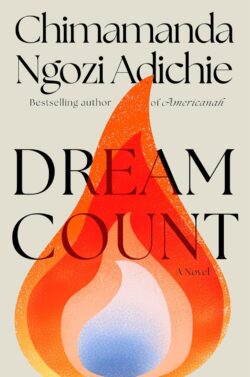
Chimamanda Ngozi Adichie’s Dream Count is a sweeping, polyphonic narrative that explores the interior lives of four Nigerian women Chiamaka, Zikora, Omelogor, and Nafissatou whose paths cross through friendship, family, and shared history. The novel is framed by the COVID-19 pandemic, a “collective sequestering” that forces the characters to sift through their pasts, name their long-unspoken yearnings, and reckon with the “dream count” of their lives. At the heart of the book is the longing to be truly known by another human being, a desire that drives the characters through various romantic entanglements, professional struggles, and personal tragedies.
Chiamaka: The Seeker of “The Known”
Chiamaka, a travel writer living in suburban Maryland, serves as the primary consciousness of the novel. During the lockdown, she experiences a “spiraling inside a bottomless well” of anxiety, obsessed with the shifting warnings of the pandemic. The silence of her neighborhood, stilled road, and the sudden boldness of local deer mirror her internal disorientation. She spends her days in “formless” time, unable to write, and finds that Zoom calls only hollow out the distance between her and her loved ones.
Her narrative is defined by a retrospective “dream count,” a literal and metaphorical tally of the men she has loved or failed to love in her search for someone who might truly know her. This search leads her to reflect on several key figures:
- Darnell: An academic art historian described as the “Denzel Washington of academia,” Darnell is a man of “coiled beauty” who exerts a gravitational pull on Chiamaka. However, their three-year relationship is defined by emotional manipulation and class tension. Darnell frequently mocks Chiamaka’s wealth, calling her a “princess” and making “acid humor” jokes about her family’s “old Igbo money” exporting palm oil that made the soap used by White elites in the 1880s. He demands she be “unusual” and “interesting,” viewing her desire for “old fashioned love” as “pedestrian”. This forces Chiamaka into a cycle of lying to please him. The relationship eventually collapses in Paris, ostensibly over Chiamaka ordering a “vulgar” mimosa at an elegant bar, but truly because Darnell’s need for control and his “lordly disappointment” have “bled dry” the reason from her love.
- The Englishman: Met online and later in London, the unnamed Englishman offers a “grandeur” in his simplicity that Darnell lacks. With him, Chiamaka feels she can “lay bare all my quiet hungers”. However, after weeks of “charged” but platonic long walks through London, he reveals he is married. Chiamaka chooses to stay with him, entering a “cycle” of waiting for him to end his marriage, a promise he never fulfills. The relationship ends when she returns to America, leaving her with a “tidal rush of memory and regret” at a London train station years later.
- Chuka: A successful, “proper” Igbo engineer who is “stable and steadfast”. Chuka is the man who “makes sense” on paper; he is Catholic, Igbo, and interested in her family. Unlike her other lovers, Chuka truly understands her, famously telling her that “White people don’t think we also dream” when a publisher tries to pigeonhole her travel writing into a “struggle story” about war and rape. Despite their intense physical passion and his willingness to “honor” her through marriage, Chiamaka rejects his proposal. She realizes that marriage to him feels like an “ending” rather than a beginning, and she cannot ignore the “exquisite ache” of not loving someone who is perfectly “lovely”.
- Luuk and Johan: Luuk, a Dutch executive, and Johan, a Swedish freelancer, represent Chiamaka’s “tall thin white men phase”. Luuk is full of “flagrant, flaming charm” and luxury, but his relationship with his ex-girlfriend Brechtje and his family’s history with Nazism create a “cloud of shame” he tries to outrun with laughter. Johan offers a “nice” and “light” relationship based on a mutual passion for travel, but they part ways after a dinner party in Germany where Chiamaka is confronted with subtle, culturally-coded antisemitism and racism that Johan dismisses as an “American interpretation”.
Zikora: The Trial of Motherhood and Abandonment
Zikora, Chiamaka’s best friend and a high-powered DC lawyer, provides a harrowing counterpoint to Chiamaka’s romantic seeking. Her arc centers on her unplanned pregnancy and abandonment by Kwame, a man she believed was her “answered prayer”. Kwame, who previously spoke of their future in the “first person plural,” reacts to the news of the pregnancy with a “shrug” and retreats into silence, eventually blocking her number and sending her apartment key back by courier.
Zikora’s experience of labor is described in visceral, “animalistic” detail. She feels “forsaken,” trapped in a “vicious, crushing” pain that she compares to an Old Testament plague. Her struggle is compounded by the presence of her mother, a woman who demands “stoic” endurance and “dignity” above all else. The relationship between Zikora and her mother is strained by the history of Zikora’s father, who moved out to live with his “second wife,” Aunty Nwanneka, leaving Zikora’s mother to perform the role of the “Senior Wife” with “ashen rituals” of respect.
However, the aftermath of the birth of Zikora’s son, Chidera (or Okey), brings a “remarkable” unfolding of her mother’s character. In the quiet of Zikora’s apartment, her mother reveals two major secrets:
- She had a hysterectomy after Zikora’s birth and could never have more children.
- The “miscarriages” she spoke of for years were a pious lie told to protect her status as a “wife without a womb” in a culture that valued sons.
This revelation bridges the gap between Zikora and her mother, as Zikora realizes her mother is “becoming a person before her eyes,” one who understands that “men say all kinds of things” and “it is what they do that matters”.
Omelogor: Power, Fraud, and the Critique of the “Pious Class”
Omelogor, Chiamaka’s cousin, is a “gleaming” star in the finance world of Abuja. Her arc explores the moral complexities of Nigerian power and her searing critique of Western liberal ideology. Omelogor’s past in banking involves “painting fraud in pretty colors,” moving millions for “murderous” governors, and laundering money. Yet, she justifies this by creating the “Robin Hood” grant program, where she steals packets of cash from these corrupt deals to give to women with small businesses in her village.
After a brief, disastrous stint in a Master’s program in the United States, Omelogor returns to Nigeria with a “jaundiced spirit”. Her time in America is defined by a series of “surprising slaps” from the “pious class” of liberals. She is condemned by her classmates for “weaponizing” the murder of her Uncle Hezekiah during a riot in the North, with a “multiracial” student accusing her of “Islamophobia”. Omelogor views these Americans as “provincial,” “dead to human foibles,” and unable to laugh, noting that they “policing your language” rather than addressing real issues.
Back in Abuja, Omelogor runs her own consulting firm and manages a complicated relationship with Hauwa, a Northern woman whose “blithe open simplicity” and “high peal of laughter” offer Omelogor a unique form of contentment. She also runs a website called “For Men Only,” where she offers blunt, unsentimental advice to men about sex, communication, and the “nonsense” of pornography. Omelogor’s narrative also involves her “custody” of Atasi, a Gbagyi girl she accidentally hit with her car years prior, whose ongoing “submerged sadness” and body image issues haunt Omelogor as a sign of her own failure to teach “hope and happiness”.
Nafissatou: The Weight of Violation and the Gift of Dismissal
Nafissatou, Chiamaka’s housekeeper, is a Guinean immigrant whose life has been a “cruel promise of loss”. Her backstory is one of serial trauma:
- She loses her beloved father in a mining accident.
- She is subjected to female genital mutilation (FGM), which she recalls as “horrendous pain” that made her feel “detached” from her lower body.
- Her brilliant sister Amina dies during surgery to remove uterine growths.
- She is raped by Francois, the owner of a restaurant where she worked in Guinea.
- She is forced to lie on her asylum application by her boyfriend Amadou, claiming she was raped by soldiers to ensure her entry into America for the sake of her daughter.
The central event of Nafissatou’s present life is her sexual assault in a DC hotel by a “naked White VIP”. The assault is “animalistic” and “possessed,” and the subsequent investigation is a second violation. She is subjected to an invasive “head-to-toe” medical exam where her most private parts are photographed, and her own “worn” underwear is taken as evidence.
The legal case becomes a media circus, with the press labeling her a “prostitute” and a “con artist” after discovering the inconsistencies in her asylum story and the drug-dealing past of her boyfriend Amadou. The prosecutors, led by the “icy” investigator Bob Mooney, treat her with contempt, implying she “must have agreed to sex in exchange for money”.
In a stunning subversion of the typical legal thriller, the climax of Nafissatou’s story is not a courtroom victory but the dismissal of the charges. While Chiamaka and Omelogor are outraged by this “shabby consolation prize” and the “madness” of the government dropping the case, Nafissatou’s reaction is one of profound relief and joy. She has “dreaded” the court case, crying at night at the thought of answering questions about her private life on a public stage. The dismissal allows her to “unfold” and become anew, finally free from the “machete” of the legal system that would have hacked at her story until she was “left with nothing but shame”.
Themes: Class, Race, and the Performance of Self
Throughout these interconnected stories, Adichie explores several recurring themes:
- The “Performance” of Africa vs. The Reality: Chiamaka struggles with editors who want her to write about “struggles” like the horrific rapes in Congo to create “debut buzz,” while she wants to write “light and quirky” pieces about restaurants in Malabo or the smell of donkey manure in Santorini.
- The Burden of Wealth: The novel depicts the “Lagos Big Man” culture Afam’s “power in his pockets” and the opulent houses with electronic gates that become barricades during the pandemic. Class provides armor, but as Omelogor notes, it is a “porous armor” that cannot protect against “biological hysterical constraints” or the loss of loved ones.
- The Hierarchy of Slavery: In a pivotal scene, Chiamaka, Darnell, Omelogor, and Zikora debate the history of the slave trade. Omelogor argues that there is a “hierarchy of slavery,” distinguishing the “industrialized” and “barbaric” Transatlantic trade that turned people into “bits of wood” from the indigenous African systems where slaves were still “human” and could be “absorbed into the family”.
- The Inevitability of Not Being Known: Despite the central longing to be “truly known,” the book suggests a tragic limit to human understanding. Zikora realizes she may never have truly known Kwame, and Chiamaka concludes that she “allowed” men like Darnell to be cruel because she believed love “must ask something of us”.
The novel ends with the lifting of the lockdown, a return to the “small wonders” of life, such as stopping to look at a bird on a tree. While the characters carry the “serrated scars” of their pasts and the “useless feeling” of regret, they remain “alert” to the possibility of a world that can still be an “enchanted place again”. The “dream count” is never truly complete, but the act of naming their yearnings allows the women to move from a state of ” ancient confusion” into a new, albeit fragile, clarity.